01403 888 222

UK Log Cabins - standard or custom garden buildings

Contact us
  • Home
  • Log Cabins For Sale
  • Other Garden Buildings
  • About Us
  • Contact Us
    • Sussex Showroom
  • UK Log Cabins Info Blog
  • My account

UKlogcabins blog page

Read useful info here about our cabins and garden buildings.

Ask us a question and we'll do our best to answer you as soon as we can by posting a blog in this page.

14 August 2022 By Keith Lynch

Painting a log cabin after installation

This is a hint worth knowing about!

When painting a log cabin you need to be aware that the log cabin will settle down immediately once built. It doesn’t matter how hard you hit the logs as you are building it (for instance, one log may bow down a millimetre or two. But the next log on top may bow in the opposite direction – suddenly you cabin is 3 or 4mm higher). The weight of the roof bearing down on the cabin walls is enough to start straightening these “imperfections” out, but this take a little bit of time of course. It is easily possible for a cabin to settle down 50mm in the first few weeks.

Decades of experience

We have actually built very tall cabins that have settled 100mm! The taller the cabin, the more it will settle down. This is because it is made with more logs and therefore more joints between the logs which need to “mould” into each other. It is also a fact that the thicker the wall logs, the longer it will take to settle down (they are stronger and so will resist this compression phase for longer).

So that’s the initial settlement phase of a log cabin, but there is also the seasonal change as well…..

PAINTING A LOG CABIN DURING SUMMER

As the air temperature and moisture content decrease, the wall logs will also reflect this change. Depending on the exact use of the timber, “normal” moisture content for softwood timber for external use is around 19%. When timber loses moisture, it shrinks. In extreme cases, ie heatwaves, external timber can reach below 5% moisture content. This means that a typical 135mm high log could reduce down to 132mm. This doesn’t sound like much. But if a cabin is 15 logs high, it means the cabin can be 45mm shorter than it’s equilibrium status (during Spring and Autumn)!

PAINTING A LOG CABIN DURING WINTER

Conversely, timber swells when it gains moisture content (who remembers the old style wooden kitchen doors jamming up in the Winter???). This is where using a good quality timber treatment/paint comes in. This will stop too much rain getting to the timber face and stop too much being absorbed which would cause the logs to swell. And if left unprotected long term, going rotten of course. Nonetheless, the moisture content of the logs will increase during Winter regardless. This therefore means the cabin could be as much as 20mm taller than it’s yearly average.

So that is the background to this article – log cabins move up and down!

The easy solution

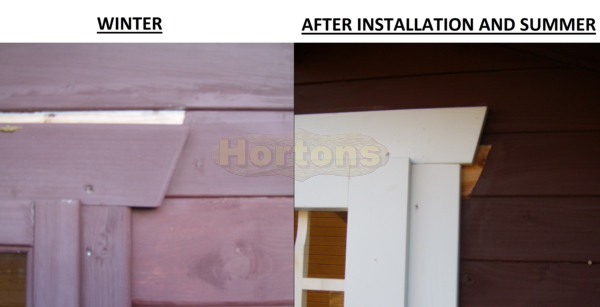
This then leads on to a helpful hint when painting a log cabin. Bearing in mind that people usually paint it in the first few days after installation. This is correct as per T&C’s but it is also before any of the settlement / movement has happened. Most people would paint around the window and door trims / architraves……But what happens when the cabin walls move?…….

Winter – the walls swell up, leaving potentially unpainted wood showing above the frame.

Summer – the walls shrink, leaving unpainted areas below the architrave “haunches”.

There is of course a very simple solution that most people don’t think of. Which is to unscrew the top trims from the frame before painting. And then replace them when the painting is complete – it’s as simple as that! It doesn’t matter what time of year it is (ie the timber moisture content, and so the height of the cabin) – the cabin will still move up and down (as it should do) but there won’t be any unpainted timber showing.

In a perfect world…..

The more all-encompassing way to paint a cabin is painting it before installing the windows and doors – which gives all round protection to all of the logs, even the hidden parts no longer in view. Thus ensuring a longer cabin lifespan.

The best option is one that not many other companies offer (but we do!) – factory painting. Not only are all logs (including the tongues, grooves and all notches), windows, doors, fascia boards painted all round (twice) but you get a much better finish because of the spray paint (or stain) finish, so there are no brush marks at all.

Filed Under: UK Log Cabins Info Blog Tagged With: Log cabin movement, Log cabin painting

7 August 2022 By Keith Lynch

Damp proof membranes for log cabins

Log cabins need damp proof membranes! There are many companies selling log cabins, but very few that provide a damp proof membrane (DPM) for their cabins. Nor even advise customers about this.

There are a few main reasons why cabins don’t last as long as they should do. The major one being the lack of a DPM which prevents damp rising up into the base timbers. Then it progresses up further into the cabin floor an wall logs……. “The bearers are pressure treated, so it doesn’t need one” – WRONG! The base timbers will eventually rot, even if treated. The base timbers will transfer this moisture up into the floor boards and bottom wall boards. Such a shame to have to replace a cabin when just a few extra pounds would eliminate this problem from the outset. Installing log cabins correctly saves years of heart-ache later on, simple as that!

Correctly installing DPM is essential

So laying a DPM is essential in our view, but it’s also how it’s laid that also makes a big difference. Cutting it off around the edge of the floor / bearers just exposes open edges at ground level. Therefore rain / rain water will get on top of it and run in under the building. With nowhere to go because the DPM is waterproof! Even worse if there’s a dip in the base. This will cause a puddle under the floor. Then the water could evaporate creating a high air moisture content, which will rise up through the floor. The last stage is what causes the damage. It transfers into the building where it will condense on any colder surface. This “water” looks like there is a leak (especially if it condenses on the underside of the roof).

This is not fantasy, we have seen this actually happen. This could also happen if the bearers are just laid on strips of damp proof course. Although not as likely, assuming the ends of the bearers are open and will therefore ventilate.

The method

The best way to lay a DPM is if it is over-size and then laying the bearers on top of it. Crucially the excess DPM is folded back on top of the bearers before building the walls. This way there are no cut edges at ground level, ensuring it stays dry. Our DPM kit also adapts the floor to include an extra timber cover fillet all around the edges. This covers the exposed DPM, Thus protecting it from UV degradation and also mechanical damage (strimmers etc)…..

If you have an insulated floor, then the spaces between the bearers is full of insulation. Hence there are no air gaps and therefore nothing to ventilate (warm deck). If it is not an insulated floors then the spaces between the bearers need ventilation. This can be easily achieved by drilling a series of holes along the appropriate flank. Drill these with an upward angle at least 30mm up from the bottom so if any water does find it’s way to the opening, it will simply run back out again.

These damp proof membranes for log cabins measures will probably at least double the life of your cabin. Easy when you follow the correct installation method, and only a few pounds extra.

Filed Under: UK Log Cabins Info Blog Tagged With: Damp proof membrane, Log cabin DPC, Prevent rising damp in garden buildings

24 July 2022 By Keith Lynch

Log Cabin Maintenance Service

We have had many enquiries over the years asking whether we offer re-roofing services, painting services and other maintenance options. This is very common most recently. Therefore we have decided to add a log cabin maintenance service to our repertoire.

Log cabins aren’t like other types of garden buildings. If you don’t know what you’re doing, you can do more harm than good. There have been many instances over the years where a customer has employed a jobbing builder or handyman. Apparently they “have been doing this type of works for decades and I know what I’m doing!”………..Guess what – they think it’s a shed and start nailing and screwing everywhere. This then stops the logs from moving (they must be free to move) and causing all sorts of issues –

  • Gaps in walls
  • Lifting the roof off when the cabin settles down
  • Stopping the doors from working because the door frame has been pushed out of square
  • Simple log cabin door adjustments end up as “Sorry, you’ll need to buy a new door”!
  • You name it, we’ve seen it!

Reliable expertise

Hortons have various teams of installers who “know” log cabins and how to build them. This is essential knowledge if working on a cabin. You not only know what to do but also how to do it. There’s no point in having a theory of what to do if you do irreparable damage trying to get to the bit that you think is causing the issue. They can leave a trail of destruction – gaps in log cabins walls is a very common thing. Our installers have 2 major advantages here. They will almost certainly know what the problem is being caused by. AND they know how to rectify it without destroying the building.

Don’t just do a repair and then forget about it for another 10 years! Maintain your building

There is also ongoing maintenance to be considered – re-painting, re-roofing, adjusting doors and windows, etc. We can also offer our log cabin maintenance service. Our company also has a big advantage here. We stock many of the items required to carry this work out (felt roll, felt shingles, insecticide & fungicide base coat treatments, spare hinges, spare wall logs, spare roof & floor boards etc). So not only can we bring these with us. But also they will be much cheaper than buying from a local timber merchant or hardware DIY store.

Replacing rotten wall logs in a log cabin

How do you replace a log in an interlocking garden cabin? We offer this as a unique service – nobody else has the expertise or equipment to be able to do this. It is nearly always the bottom logs that rot due to insufficient maintenance and/or no damp proof course being installed when it was originally built. Log cabins are built by layering the wall logs from the bottom up, overlapping at the corners – so how do you replace the bottom log??? Quite simply, we have purpose built heavy duty equipment which enables us to actually lift the whole cabin up! Then we can drop the bottom logs out from underneath, replace with fresh logs and then lower the cabin back down again. We can even replace the floor and/or floor bearers whilst it is up in the air – and even in extreme cases, lay a new concrete base for your cabin before lowering it back down again!

Any garden cabin repair is possible if you have the experience, know-how and the proper equipment

Don’t believe odd-jobbers saying it’s not possible when they visit to quote for your log cabin repair. And please don’t let them cut and splice replacement logs in for just a few quid – you will regret it when it starts to leak soon afterwards.

Whatever you need doing to your garden outbuilding (including sheds, garden workshops, log cabins, summerhouses, garages, etc) – we are able to help you – please contact us for details about how we can help you to refurbish your log cabin and make it the ideal garden cabin for you

Filed Under: UK Log Cabins Info Blog Tagged With: garden building repair, log cabin maintenance, shed re-roofing, summerhouse painting

9 July 2022 By Keith Lynch

Building regulations and planning permission for log cabins and garden buildings

Do log cabins need to comply with building regulations?

Building regulations for log cabins – there are many myths regarding this subject. As a rule, small garden building don’t need to comply with Building Regulations (this is different to planning permission). Building regulations concern themselves with structural stability, insulation values. And also generally how well built the structure is. Whereas planning permission is generally concerned with where you put it and how it looks.

Hortons 4×4 log cabins and smaller do not fall under any restrictions in a garden regardless of where site them. Unless it is within a conservation area or ANOB, in which case you would need to check with your council. Most people know about the planning permission side of things – the main one is “under 2.5m high if close to a boundary”. And “less than 50% of garden area”, plus may be some others). BUT most people aren’t aware of Building Regulations. Complications can arise if it’s going to be more than just a summerhouse / shed / game room type structure. Once deemed as habitable or semi-habitable then that’s a whole new ballgame.

Building regulations for log cabins? Yes, for larger cabins

All buildings over 30sqm “INTERNAL FLOOR AREA” require Building Regs approval (quite a few people know this). This also includes the base as well – do not buy a Building Regs compliant building and think you can just build it on an existing base. You may come unstuck! Bases will need to comply by using the standard Building Control specifications for your area. These are usually way over the top for a timber garden building. Employing a structural engineer to calculate what is actually required pays in the long run. This may cost a bit to start with but usually saves a fortune because the base calculations prove what the specification required is. Which is nearly always to a much lower spec once the calculations are shown to the council official).

It is also true that some buildings between 15sqm – 30sqm also fall within Regs as well. But this is only for 1 specific set of circumstances…. If sited closer than 1m to ANY boundary then it needs to be “constructed substantially of non-combustible materials”. We offer factory applied fire protection coating to Class B – s1,d0. This used to be universally accepted by all councils but we cannot guarantee this to be the case any more. You will need to check with your local Building Control department. Most companies do not have a clue about this. Or if they do, then they keep quiet as they are much more interested in knowingly taking your order without either offering a solution or telling you to contact the council.

Smaller garden building do not need to comply with building regulations

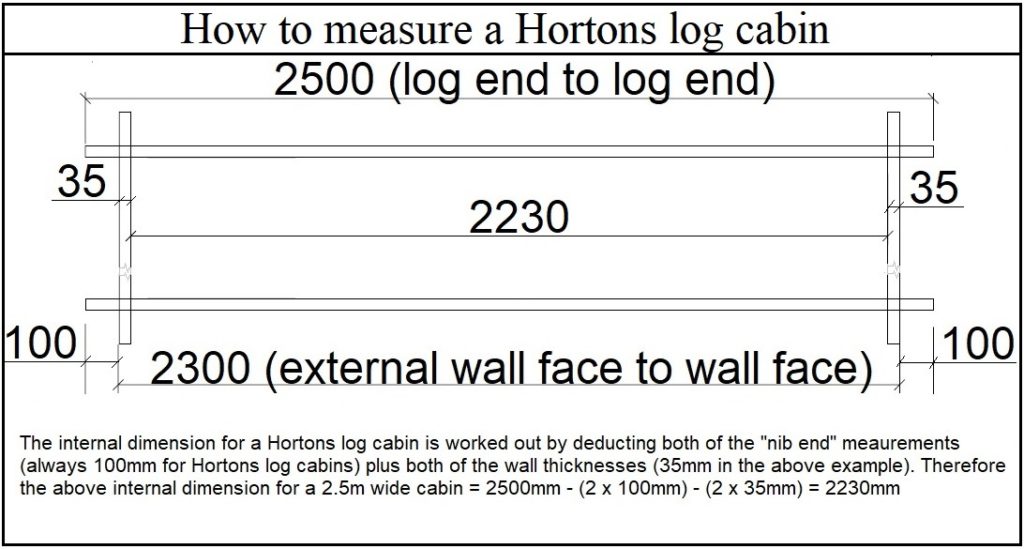
However, any garden building of less than 15sqm internally don’t need to comply with this regulation either. We measure our log cabins from log end to log end, so allowing for this and for the wall thicknesses as well (which vary) then Hortons 4x4m cabins (16sqm externally) come out to be just less than 14sqm – although the external size is 16sqm, the internal footprint for a 45mm wall log cabin is just under 14sqm, so it can be built anywhere in your garden (even right up to the boundary should you wish, however think about future maintenance before you decide to do this! We will address this topic in a later blog.). This is how to work out the internal measurement for one of our cabins –

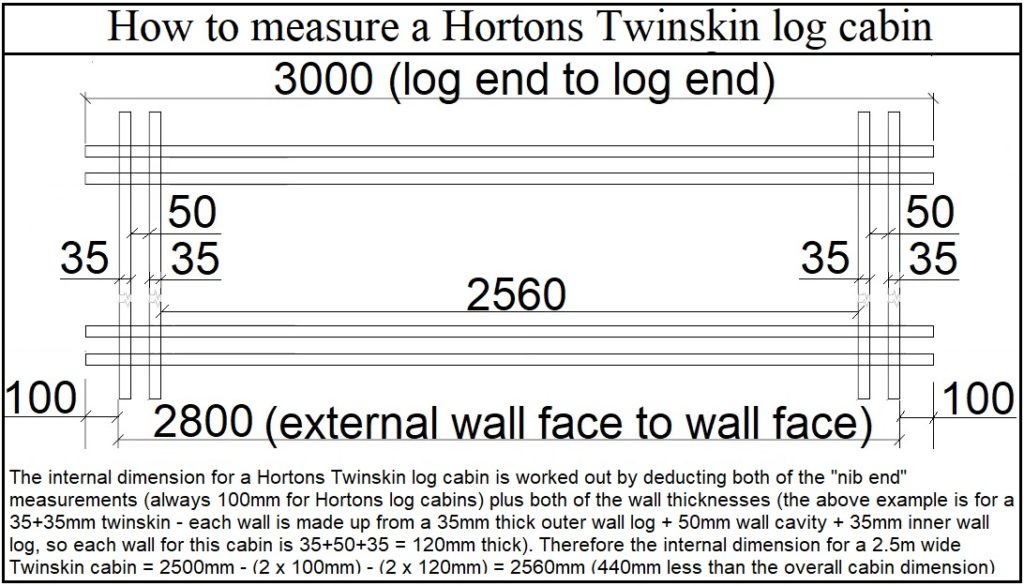
There is a little bit more to consider if you are looking to buy a Twin Skin log cabin as there is another wall thickness and wall cavity to include within the calculations as well –

Log cabins and Building Regulations

Is planning permission complicated for garden buildings?

There are only few regulations that generally apply to log cabins and garden buildings. We do not offer advice regarding this subject, however this link to the government website for planning permission covers the very basics rules that apply. WE do advise that you check with your local council if you are in any doubt (especially if you are within an AONB (area of outstanding natural beauty), conservation area or a national park)

Filed Under: UK Log Cabins Info Blog Tagged With: Building regulations for log cabins and summerhouses

26 June 2022 By Keith Lynch

Flexible cabin designs

A very common question from customers is “How flexible or fixed are our log cabin designs”? The simple answer is that they aren’t fixed at all.

So the next question (quickly following that answer) is “Does that cost a lot extra?”. This is another very simple answer – “Very little, possibly nothing at all or even that it could cost less depending on what needs changing”. All of the styles and designs on our website are purely there as a starting point to give ideas to customers. If the customer needs fewer windows or doors, then it’s probably going to cost less. If doors or windows need moving to a certain position (but the total number remains the same) then there may be a very small charge for this. Or there may not, depending on what else is going on with the cabin. Adding partitions, for example, to make into a multi room log cabin will obviously cost more.

Don’t settle for second best!

The upshot is simple – we have our own dedicated factory. Therefore we can be as flexible as required and for very little (or no) extra cost. The way to think about it is that cabins (and all garden buildings) are timber boxes with windows, doors and canopies – you choose where you want them and how many, and leave the rest to us. This even applies to our residential log cabin houses – you tell us what you need.

log cabin with 2 rooms

In summary, if it is possible to draw a design, then we are able to make and install it.

NB – it is always worth pointing out that there my be certain restrictions that apply and you should always research planning permission and building regulations. Follow these links to the relevant government website for more info –

Planning permission for garden buildings – http://www.planningportal.gov.uk/permission/commonprojects/outbuildings/miniguide

Building Regulations for garden buildings – https://www.planningportal.co.uk/info/200130/common_projects/43/outbuildings/2

We offer many different cabins that have no restrictions. This makes it much easier and simpler. There are ways to design garden buildings so they don’t require any planning permissions or planning applications. Some of them can be seen here – https://www.uklogcabins.co.uk/log-cabins/

Filed Under: UK Log Cabins Info Blog Tagged With: custom log cabins

  • « Previous Page
  • 1
  • 2
  • 3
  • 4
  • 5
  • Next Page »

Contact us

"*" indicates required fields

This field is for validation purposes and should be left unchanged.
Your postcode*

Contact Information

01403 888 222

Visit our contact page:
Click here

The Log Cabin Showground
Handcross Road (B2110)
Plummers Plain, Lower Beeding
Horsham
West Sussex, RH13 6NX

Our log cabins are designed with easy installation in mind, whether you will be installing the cabin yourself or using our installation service.
Our experience means that we have developed our cabins over decades ensuring stability, functionality and longevity. There are many of our cabins over 20 years old and still going strong!

About Us

We supply high quality log cabins and wooden garden buildings. With experience providing outdoor timber structures to customers across the South of England and the rest of the UK, we are happy to provide you with any advice you need.

Read more...

Tag Cloud

Building garden cabin Building regulations for log cabins and summerhouses cabin videos composite custom log cabins Damp corners in log cabins Damp proof membrane decking double glazed cabin windows Fire proof garden building Garden building cladding garden building repair Garden building roof repairs garden cabin joinery garden room videos Garden sheds Horsham Greenhouses How to build a garden cabin Install a log cabin Log cabin DPC Log cabin installation video log cabin maintenance Log cabin movement Log cabin painting Log cabin repairs log cabin windows maintenance free garden cabin Maintenance free garden room Mobile home chassis New log cabin window Prevent rising damp in garden buildings Protecting a log cabin against weather PVCu doors for log cabins replacement log cabin window rot free log cabin Rotten logs in cabin shed re-roofing Sheds for sale shed videos summerhouse painting uPVC fascia boards uPVC windows for log cabins Winterised log cabin

Resources

  • FAQ page for garden cabins
  • Installation guide for Hortons UK Log Cabins
  • Raised timber base kit installation
  • Building regulations and planning permission for log cabins and garden buildings
  • Damp proof membranes for log cabins
  • Log Cabin Maintenance Service
  • Log cabin repairs
  • Static caravan chassis
  • uPVC windows and doors for Log Cabins and Garden Buildings
  • Log cabin videos

Contact Information

01403 888 222

Visit our contact page:
Click here

The Log Cabin Showground
Handcross Road (B2110)
Plummers Plain, Lower Beeding
Horsham
West Sussex, RH13 6NX

  • Hortons Log Cabins iconHortons Group
  • Facebook linkFacebook
  • Youtube linkYoutube
  • Twitter / X linkTwitter
  • Google reviewsGoogle Reviews
  • Pinterest linkPinterest
  • Instagram linkInstagram
  • WhatsApp link for Hortons Log CabinsWhatsApp

COPYRIGHT © Hortons Group - 2025 Registered in England: 4684795 -   Privacy Policy   Terms and Conditions