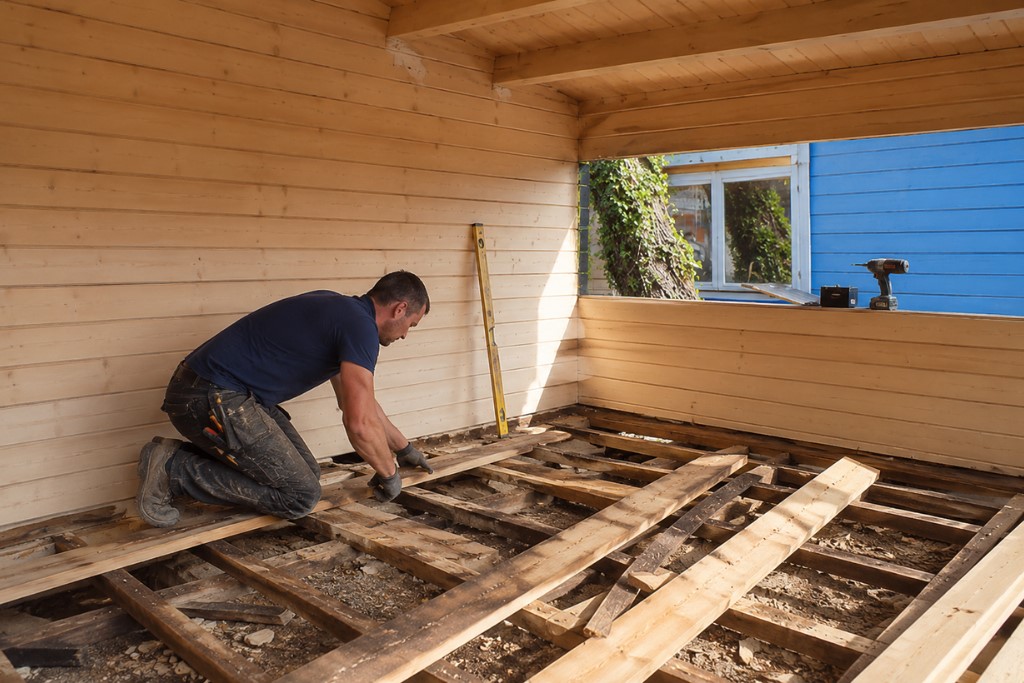
Quick Answer
A rotten log cabin floor is very often not just a flooring problem. Where a cabin was built without a damp-proof membrane under the floor bearers something that’s surprisingly common, since many suppliers don’t fit one as standard moisture from the ground can rot the bearers first, and the floor above simply goes soft or bouncy as a symptom. A proper repair means establishing what’s actually happening underneath, then lifting the cabin if needed to inspect and replace the bearers, fit a damp-proof membrane, and lay new flooring, rather than just screwing down new boards over a problem that might still be there underneath.
At a Glance
- A soft, bouncy, or sinking floor is usually a sign of rot in the floor bearers underneath, not just the boards on top.
- A damp-proof membrane between the timber and the ground isn’t fitted as standard by every supplier; where it’s missing, that’s very often the root cause behind bearers failing years before the rest of the cabin.
- Because a log cabin’s walls interlock and sit directly on the floor bearers, the bearers are effectively trapped underneath the structure; replacing them properly means lifting the whole cabin, not working locally.
- Simply lifting the visible floorboards and screwing down new ones, without addressing what’s underneath, tends to fail again within a year or two.
- Repair is very often the cheaper option once you factor in the full cost of replacing a cabin: demolition, disposal, a new build, and reinstalling everything from electrics to a base.
The Surface Problem: “My Floor Feels Soft, Bouncy, or Like It’s Sinking”
This is usually where it starts. You notice the log cabin floor feels soft in one spot, or a bit bouncy when you walk across a particular area, or in more advanced cases, that it feels like it’s genuinely sinking slightly underfoot. It’s a natural instinct to treat this as a flooring problem: lift the affected boards, see what’s there, maybe replace a section.
The trouble is, floorboards are rarely the whole story. What you’re feeling through your feet is often the first sign of something happening beneath the floor, not within it.
Why a Rotten Floor is Rarely Just About the Floor
Here’s the detail that changes how this should actually be approached: log cabins are built up from a set of floor bearers the timber joists the whole structure, including the walls, sits on. A properly specified cabin will have a damp-proof membrane separating those bearers from the ground or base underneath; it’s good practice, and it’s something we offer with our own buildings. Not every supplier fits or even mentions this, though, and it’s a detail that’s easy to miss on an older cabin or one bought elsewhere. Where it’s missing, moisture can work its way up into the bearers over a long period, and because they’re hidden under the floor and trapped beneath the walls, that rot can develop for years before it’s noticeable from above.
By the time you feel it as a soft or bouncy floor, the bearers have often already lost a meaningful amount of their strength; the floorboards are simply telling you what’s already happened underneath.
What’s Actually Underneath: A Proper Investigation
Before any repair decision makes sense, it’s worth understanding what’s actually going on, rather than guessing from the symptom alone. A proper check looks at:
- How the floor responds underfoot. Genuine give or bounce, rather than a single squeaky board, points toward the bearers rather than just the surface.
- What the base is, and its condition. Log cabins sit on a range of base types: slab, block, raised timber platform, or poured concrete, and each can develop its own issues, from cracking to subsidence to a finished level that’s ended up lower than the surrounding ground.
- What’s around the cabin at ground level. Vegetation, soil, or debris piled up against the walls holds moisture against the timber and accelerates exactly this kind of damage, as does a base that lets rain splash back up onto the cabin.
- Nearby tree roots could be affecting the base, which can happen more often than people expect with larger, established trees near a garden building.
This is genuinely worth a proper look rather than an assumption either way. Sometimes what feels alarming underfoot turns out to be a single affected area, and sometimes a cabin that looks fine from the outside has more extensive bearer damage than the visible symptoms suggest.
What Usually Causes It
A few things show up again and again behind a rotten log cabin floor:
- No damp-proof membrane between the bearers and the base is a genuinely common gap, particularly on older cabins or ones from suppliers who don’t offer this as part of the build.
- Water under the log cabin floor from poor site drainage, an oversized base that lets rain splash back onto the timber, or a finished ground level that sits above the base itself.
- Vegetation or debris against the building, holding damp against the timber over a long period.
- General lack of maintenance: timber that hasn’t been treated or repainted regularly is simply more vulnerable when moisture does reach it.
How Far the Damage Usually Extends
Rot doesn’t stay neatly confined to one component, which is exactly why a floor problem is worth investigating properly rather than patching over. The typical progression looks like this:
Floorboards only → often the first visible sign, and sometimes genuinely the extent of it if caught early.
Floor bearers → the more common finding once boards are lifted for inspection. Bearers in prolonged contact with a damp base, with no membrane to protect them, are usually further along than the boards suggested.
Bottom wall logs → in more advanced cases, moisture that’s affected the bearers has often been present long enough to reach the lowest wall logs too, since they sit directly on the same structure.
Knowing which of these three you’re actually dealing with is the difference between a straightforward repair and a significantly bigger job, which is exactly why guessing from the surface symptom alone is worth avoiding.
Why the Fix Isn’t as Simple as “Lift the Boards and Screw Down New Ones”
A typical general-purpose repair approach looks something like: take up the damaged boards, buy replacement timber, screw it down, treat it. For a garden shed with a simple floor, that might be enough. For an interlocking log cabin, it usually isn’t, for two reasons.
First, floorboards in most cabins are nailed down, and taking them up without damaging them is close to impossible in practice, so new floorboards are typically needed regardless of what’s found underneath.
Second, and more importantly: log cabin walls are built upward from the floor bearers, interlocking log by log as they go. That means the bearers aren’t a separate, freely accessible component sitting under a floor you can lift away from the walls; they’re structurally trapped beneath the entire building.
You can’t simply prise up a section of bearer from the side without the wall sitting on top of it. If the rot has reached the bottom wall logs as well, the same problem applies to them too: an interlocking log can’t just be pulled out and swapped like a single plank.
This is where a well-meaning but unspecialised repair often goes wrong. Cutting a damaged section out and splicing in a repair piece with glue, filler, and screws might look acceptable for a season, but it doesn’t restore the structural interlock, and it very often ends up leaking again before long. If you’re getting quotes for this kind of work, it’s worth asking directly whether the contractor has worked on interlocking log cabins specifically, and how they actually intend to access and replace the affected timber.
The extent of what’s needed does vary with how much damage there is, but for anything beyond a single surface-level board, a proper fix generally means getting the affected section properly clear of the structure to replace it cleanly, rather than working around it in place.
What a Proper Repair Actually Involves
This is the part of the process most people don’t know is possible, and it’s the reason a rotten floor doesn’t have to mean a lost cabin. Rather than working around the walls, the entire cabin can be lifted using hydraulic equipment, clear of the base, so the damaged components underneath are properly accessible rather than trapped:
- The cabin is lifted and supported, clear of the floor and base, exposing the floor bearers (and bottom wall logs, if they’re also affected) fully for the first time since the cabin was built.
- The damaged floorboards, bearers, and any affected bottom logs are removed. In more serious cases, where the base itself has failed, a new concrete base can even be laid while the cabin is still suspended.
- A proper damp-proof membrane is installed between the new base and the new bearers where this was missing in the first place; this is the detail that actually prevents the same problem from happening again.
- New floor bearers, floorboards, and any replacement wall logs are fitted, and the cabin is lowered back down onto the new, protected structure.
- Windows and doors are rehung and adjusted as needed, since a small amount of movement during the lift is normal and easily corrected on the way back down.
The result is a floor and base that are actually protected against the same problem happening again, rather than a repair that looks fine until the same underlying moisture issue resurfaces.
Repair or Replace? How to Decide
This is a genuinely fair question, and the honest answer depends on a few things: how far the damage extends (floorboards only versus bearers versus wall logs), the condition of the rest of the cabin, and what a full replacement would actually cost once every stage is accounted for.
It’s worth totalling the full picture before assuming replacement is the cheaper or simpler option: demolishing and disposing of the existing cabin, the cost of a brand new one, reinstalling a base if needed, reconnecting electrics, repainting, and the general disruption of losing use of the space during a full rebuild. Once all of that is factored in, a proper repair, even one involving lifting the whole structure, is very often the more cost-effective route, and it avoids the hassle of starting again from scratch. That said, there are cases where the wider condition of the cabin genuinely makes replacement the sensible call, which is exactly why this is worth an honest assessment rather than a default answer either way.

Think Your Log Cabin Floor Needs Repairing?
Get expert advice from the UK Log Cabins team and find out whether your cabin needs a simple repair or more extensive work.
Request an InspectionNot Sure How Serious the Damage Is?
If you’re not sure whether you’re dealing with a few affected floorboards or something that’s reached the bearers and lower wall logs, it’s worth resisting the urge to assume the worst or the best. An inspection can establish the actual condition of the visible parts of the cabin and flag anything that needs repair or a closer look, without committing to any particular fix before it’s clear what’s actually needed.
If the inspection does show the floor or supporting structure needs attention, the repair can then be scoped around the real problem, whether that’s a straightforward board replacement or something more involved, rather than replacing parts unnecessarily or missing something that matters.
What to Do Next
If any of this sounds familiar a floor that feels soft, bouncy, or like it’s sinking in places the sensible next step is getting a proper look at what’s actually happening underneath, rather than guessing. It’s also worth reading through our wider guide to warning signs of a rotting log cabin if you’re not yet sure whether the issue is isolated to the floor or affects other parts of the cabin too.
When you’re ready, our log cabin repairs page has a specific enquiry form for exactly this kind of job, including the details we need to scope a floor and bearer repair properly. If your cabin’s floor is sound but you’d like to stay ahead of problems like this in future, it’s worth reading about our ongoing maintenance service too, and understanding why a damp proof membrane matters so much in the first place is covered in full in our DPM guide.
Not sure where you stand, or want to talk it through before committing to anything? Get in touch; we’re happy to give you a straight answer on whether this is a straightforward fix or something more involved.
Frequently Asked Questions
Why does my log cabin floor feel bouncy?
A bouncy or soft feeling underfoot is usually a sign that the floor bearers beneath the boards have started to rot, most often because there’s no damp-proof membrane protecting them from moisture in the base or ground below.
Is a soft log cabin floor always a sign of rot?
Not always, but it’s the most common cause and shouldn’t be assumed harmless. A proper inspection is the only reliable way to tell whether you’re dealing with a minor, localised issue or something more extensive underneath.
Can log cabin floor bearers be replaced without removing the whole cabin?
Not properly, in most cases. Because the walls of an interlocking log cabin sit directly on the floor bearers, the bearers are structurally trapped beneath the building. Replacing them correctly means lifting the entire structure clear, rather than trying to work around it.
Is it cheaper to repair a rotten log cabin floor or replace the whole cabin?
Repair is very often the more cost-effective route once you account for the full cost of replacement demolition, disposal, a new cabin, reinstallation, and associated work like electrics and a base. It depends on the extent of the damage, which is why a proper assessment is worth getting before deciding either way.
How do I know if water is getting under my log cabin floor?
Signs include a persistently soft or bouncy feeling in one area, a musty smell, staining on skirting or lower walls, and visible standing water or damp ground close to the base after rain. Vegetation or debris piled against the cabin, and a base that sits below the surrounding ground level, are both common contributing causes worth checking.